
Google March 2026 Core Update: What Businesses Must Know in 2026
Google March 2026 Core Update
Narasimha Reddy
8/22/20253 min read
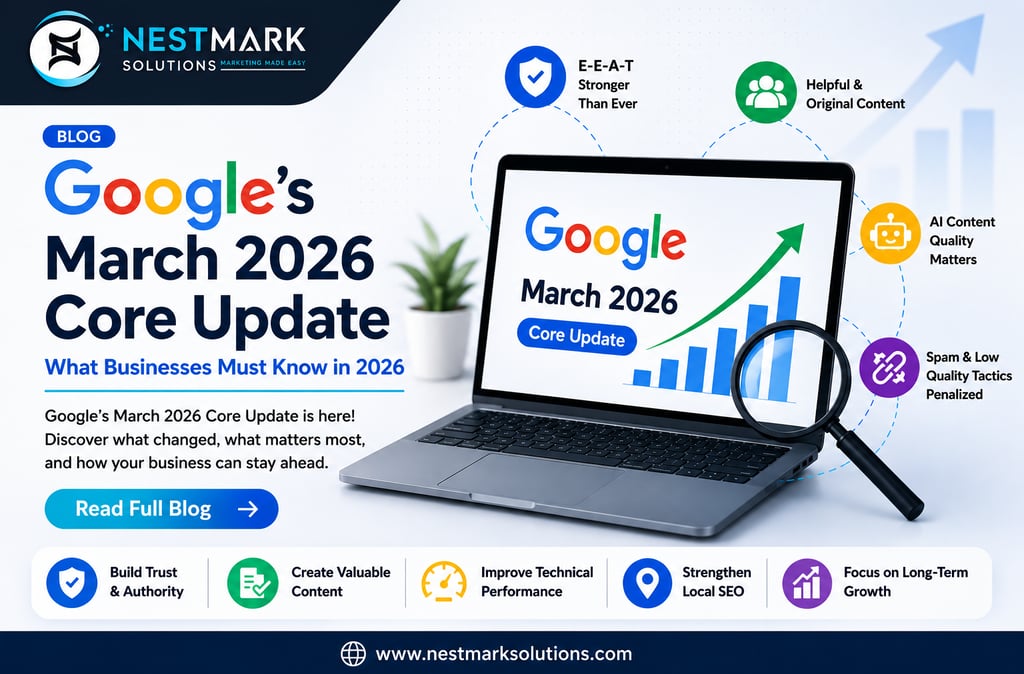
The digital marketing landscape is evolving rapidly, and Google’s latest algorithm update is reshaping how websites rank in search results. The recently completed Google March 2026 Core Update, finalized in April 2026, has become one of the most impactful SEO updates in recent years.
For businesses, brands, and marketers, this update sends a clear message:
“Helpful, trustworthy, and experience-driven content will dominate search rankings.”
At Nestmark Solutions, we analyzed the latest SEO trends and algorithm changes to help businesses understand what this update means and how to stay ahead in search rankings.
What Is the Google March 2026 Core Update?
Google officially completed the rollout of its March 2026 Core Update on April 8, 2026. The update significantly impacted website rankings across industries, especially websites relying heavily on AI-generated, low-value, or repetitive content.
SEO tracking tools reported massive ranking volatility, with thousands of websites experiencing sudden gains and losses in visibility.
Some of the major ranking shifts included:
Nearly 80% fluctuation in top-ranking search results
Reduced visibility for thin AI-generated content
Increased rankings for authoritative and expert-driven websites
Stronger emphasis on trust, user experience, and topical authority
What Is Google Prioritizing in 2026?
1. Helpful & Human-Centric Content
Google is rewarding content that demonstrates:
Real-world experience
Practical insights
Original opinions
Industry expertise
First-hand knowledge
Generic blogs written only for keywords are losing search visibility rapidly.
Businesses now need to create content that genuinely helps users solve problems instead of simply targeting search traffic.
AI Content Is Allowed — But Quality Matters
One of the biggest misconceptions in SEO today is that Google penalizes AI content entirely.
That is not true.
Google has clarified that AI-assisted content is acceptable when it adds genuine value to users. However, mass-produced AI articles without human editing or expertise are now heavily targeted.
Content types negatively affected:
Bulk AI-generated blogs
Duplicate informational pages
Thin location pages
Automated keyword-stuffed content
Content types performing better:
Human-reviewed AI-assisted content
Expert-written articles
Case studies
Localized and niche-specific content
Original research and insights
This means businesses should use AI as a support tool — not as a complete replacement for expertise.
E-E-A-T Is More Important Than Ever
Google continues strengthening its E-E-A-T framework:
Experience
Expertise
Authoritativeness
Trustworthiness
Websites with strong credibility signals are performing significantly better after the update.
Important trust signals include:
Author profiles
Company information
Customer testimonials
Business certifications
Case studies
High-quality backlinks
Consistent brand presence
For businesses, building a strong digital brand is now just as important as keyword optimization.
Spam & Low-Quality SEO Tactics Are Being Penalized
Google is aggressively targeting manipulative SEO practices such as:
Parasite SEO
Expired domain abuse
Programmatic spam pages
Keyword stuffing
Low-quality backlink schemes
Thin affiliate content
Websites using outdated SEO shortcuts are experiencing major ranking drops.
Businesses should now focus on sustainable SEO strategies built around authority and user trust.
What Businesses Should Do After This Update
Improve Website Trust Signals Businesses should:
Add detailed About Us pages
Showcase client testimonials
Display certifications and awards
Include real business information
Highlight team expertise
Focus on High-Quality Content
Instead of publishing large volumes of blogs, focus on:
In-depth content
Industry insights
Original research
FAQ-based content
Case studies
Local SEO pages with unique information
Strengthen Technical SEO
Google also continues prioritizing:
Fast loading speed
Mobile optimization
Core Web Vitals
Secure HTTPS websites
Better user experience
A technically optimized website improves both rankings and conversions.
Local SEO Is Becoming More Powerful
Local businesses are seeing better visibility when they:
Optimize Google Business Profiles
Collect authentic customer reviews
Use local keywords naturally
Publish location-based content
Add Google Maps integration
Use real project images
For real estate, healthcare, education, and service industries, local SEO has become a major growth driver in 2026.
The Future of SEO in 2026
Google is clearly shifting toward:
Brand authority
Human expertise
User-first experiences
AI-assisted but human-reviewed content
Community-driven discussions
Entity-based search optimization
This means businesses that invest in trust, branding, and expertise will continue to outperform competitors relying only on traditional keyword tactics.
Final Thoughts
The Google March 2026 Core Update marks another major shift toward quality-focused SEO.
Businesses that prioritize:
valuable content,
user experience,
credibility,
and long-term authority
will continue to grow organically in search rankings.
At Nestmark Solutions, we help businesses build sustainable SEO strategies, optimize websites for Google’s latest updates, and create high-performing digital marketing campaigns that drive real results.
If your website traffic has dropped after the latest update, now is the time to audit your SEO strategy and adapt to Google’s evolving search ecosystem.
NESTMARK Solutions
We elevate your brand through digital marketing strategies.
ENGAGEMENT
Connect With Us
marketing@nestmarksolutions.com
+91 7975676409
© 2025 NestMark Solutions All rights reserved.
USEFUL LINKS
Home
Services
Contact Us
Blog
Contact Us